Beyond Language Models: Why Coordination Can Be the Next Frontier in AI Systems

Over the past few weeks, I explored a question that I suspect will become increasingly important as foundation models continue to improve. Suppose we keep the underlying reasoning model fixed. Instead of training a larger model or changing prompts, can we improve performance simply by improving how complex problems are decomposed, executed, and recomposed?
This is a pipeline eerily similar to the challenges of source and channel coding in classical information theory, i.e. shaping the input into the form most amenable to processing in the “channel”. Reasoning in LLMs in particular appears highly sensitive to formulating the query. Complex queries by their nature can be decomposed in innumerable ways. Some of these nuances are captured during reasoning-model training, but the most specialized pathways are almost certainly not etched in. Without any change in the underlying model, we should be able to reformulate queries, and effectively improve the reasoning performance.
The Benchmark
To benchmark this direction, I built a decomposition-and-recomposition layer on top of You.com's Finance Research API and evaluated it on the public FinSearchComp T3 Global benchmark using fully live API calls throughout. The eighty four T3 level (Complex Historical Investigation) questions target multi-step reasoning across different sources, and analyzing long-term historical trends, for example
.._235 “Knowing that the Federal Reserve begins tapering on June 1, 2022, what are the S&P 500 (SPX.GI) constituents that have a total market capitalization (calculated by adding up the market capitalizations of the different types of shares on the basis of the market capitalization as of 2022.8.31) greater than the median and are among the top five decliners (without reweighting) during the period from June 1, 2022, to August 31, 2022? If there are two types of shares of the same company, the one with the higher market capitalization is used for calculation.”These are highly complex questions, but the key insight is that they follow a common pattern: parsing the question into retrieval over extended times of certain indices, performing arithmetics and comparisons and combining judgments into a final product. Those recurring patterns is where coordination intelligence can make an impact.
Before outlining the thin orchestration layer, here is the published leaderboard, on the Global T3 subset (84 questions), each model using its own native web search:
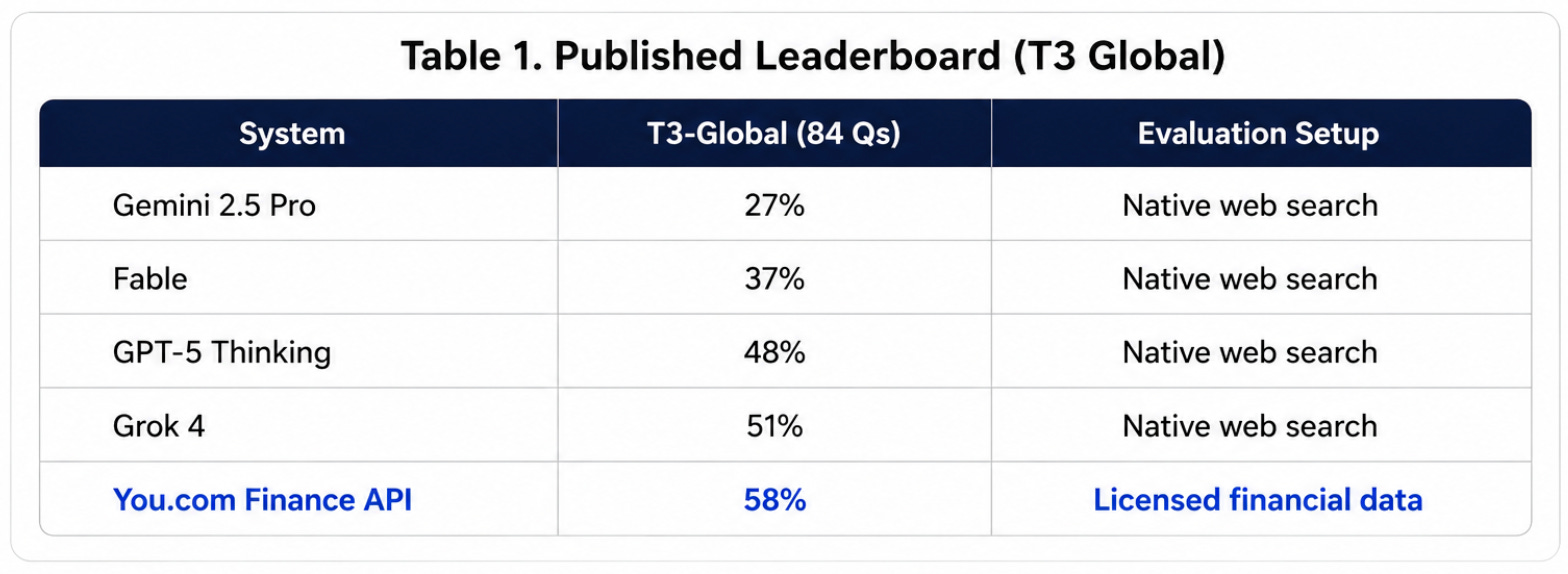
I added Fable and Gemini based on my own runs, the Gemini numbers reproduce the original paper’s number, in order to confirm my harness is on the same scale. One important insight is that larger models do not necessarily perform on this benchmark.
you.com’s Finance Research API sits at 58%, above every single model, and above the reported human expert baseline of 51%. The reason isn’t the model. It’s licensed financial data and orchestration. A strong model armed with generic web search tops out roughly 20 points lower. The moat is the data and orchestration.
To find a way forward, I checked you.com’s T3 slips expecting data gaps. That’s not what I found. The API almost always retrieves the right numbers. The misses are composition failures: it fetches four correct values across four fiscal years, then trips on a fiscal-vs-calendar-period edge. The retrieval is right, the arithmetic over the retrieval is where it breaks. That’s a fixable class of error, if you separate retrieval from computation.
The layer
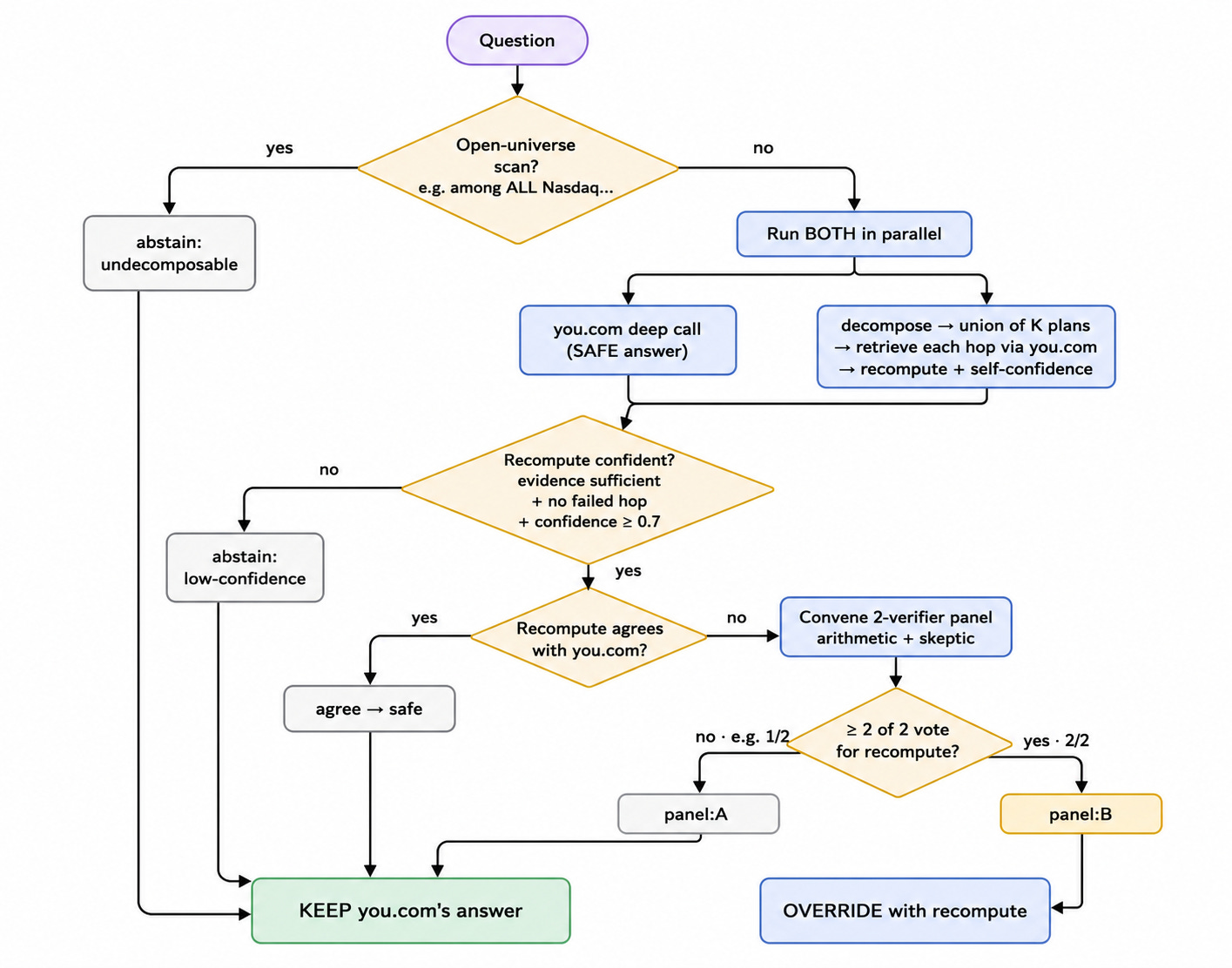
The architecture I used, outlined below, is intentionally simple:
Decompose: multiple independent decompositions: an ensemble of independent plans, unioned for coverage.
Retrieve each lookup precisely, via you.com’s same deep calls.
Recompute the answer explicitly from the itemized evidence, recomposition of evidence ledger
Arbitrate: independent verification before producing a final answer
The result
On all 84 T3-Global questions:
Current published baseline: 49/84 (58.3%)
Orchestrated system: 54/84 (64.3%)
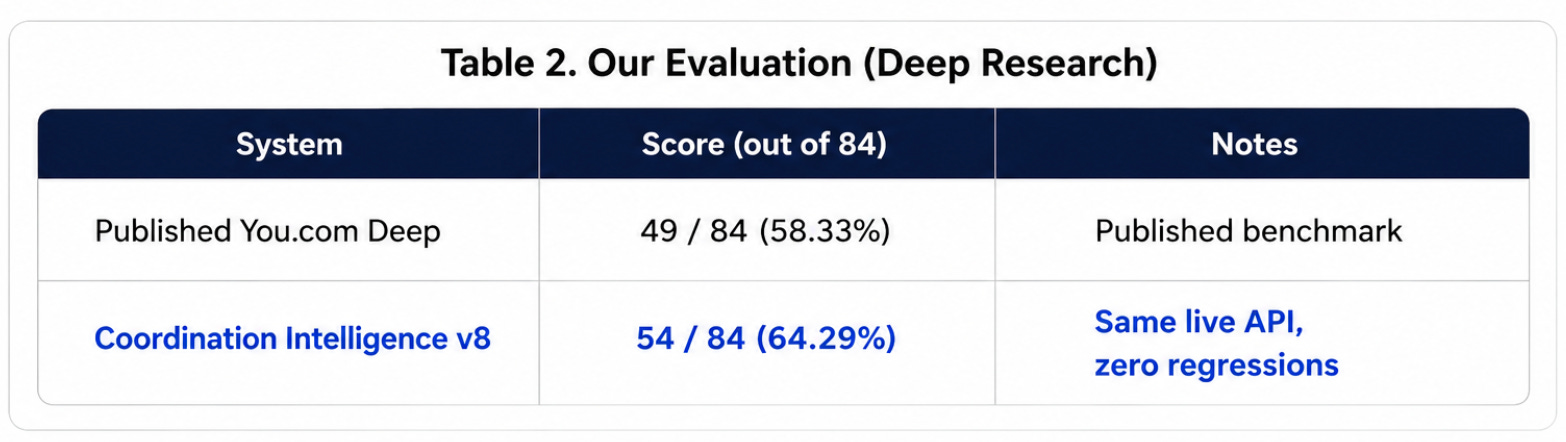
A repeatable improvement with zero regressions, produced entirely by a thin orchestration mechanism. The layer never broke an answer the API already had right. The more interesting part is the fact that the recovered failures clustered around:
compositional reasoning
multi-period arithmetic
precision calculations
Exactly the kinds of mistakes that decomposition was designed to reduce.
The layer trades some latency for accuracy: median 167s vs 139s for a single call, a modest increase.
Now on the failures that remained: many required screening or ranking over very large universes (for example, identifying extrema across hundreds of securities). Those are less about reasoning than about integrating reasoning with structured retrieval and specialized data systems. To me, this points toward a broader architectural question.
Why this matters
As frontier models continue to improve, we may increasingly optimize not only model intelligence, but also coordination intelligence:
decomposition
routing
verification
synthesis
tool selection
governance
The next gains may come not only from larger models, but from better systems around them. The accuracy frontier moves off the base model and onto the orchestration layer: which tool or agent to call, when to verify, how to recompose primitives into an answer. A strong research API plus a smart decision layer beats either alone, and that decision layer is a product surface in its own right.
Coordination itself may become a first-class optimization problem for AI systems. If so, we may eventually benchmark coordination architectures as carefully as we benchmark models today.
Code, results, and methodology are here: https://github.com/nvdm59/coordination-intelligence.